Osaka Castle Walks with Edward

Ishiyama Honganji War Timeline (1570–1580)

Quick Answers

Between 1570 and 1580 Oda Nobunaga spent a decade trying to break the Ishiyama Honganji — the fortress-city of the Ikkō-ikki warrior-monks, built on the ground where Osaka Castle now stands. Never taken by storm, it was finally starved, surrendered, and burned, clearing the site for Hideyoshi's castle.

Where was the Ishiyama Honganji?

The Ishiyama Honganji was a fortified Buddhist city on the Uemachi Plateau — the exact ground modern Osaka Castle occupies. It was the headquarters of the Jōdo Shinshū movement, and by the 1570s it was a self-governing religious capital that Portuguese Jesuit chroniclers such as Luís Fróis described as "a fortified place of great strength," "a stronghold defended by many men," and "a city of monks and warriors" — one of the strongest fortresses they had seen in Japan. (English edition: Luís Fróis, First Western Accounts of Japan's Gardens, Cities and Landscapes, ed. Castel‑Branco & Carvalho, 2020.)

Why did Oda Nobunaga besiege it for ten years?

Nobunaga's unification could not tolerate an independent, militarised Buddhist state at the heart of his domain. The Ikkō-ikki warriors and abbot Kennyo declared him an enemy of Buddhism, and attempts to storm the amphibious fortress failed — so from 1570 to 1580 he fought a grinding war of encirclement instead.

How did the fortress survive so long?

Its defences held by land, and the Mōri clan's navy kept it supplied by sea. In 1576, at the Battle of Ten'nōji, Nobunaga himself was wounded by an arquebus shot. Only after his iron-armoured atakebune warships crushed the Mōri fleet at the second battle of Kizugawaguchi in 1578 was the fortress finally isolated.

How did the siege end?

It ended not by assault but by starvation and diplomacy. With its sea lifelines severed, the defenders grew exhausted; in April 1580 Nobunaga negotiated surrender through the Imperial Court. Once evacuated, the entire complex burned, and Toyotomi Hideyoshi later built Osaka Castle on its ashes.

Experience This History in Person

Explore the stone walls, hidden moats, and battleground sites with a resident historian who lives beside Osaka Castle. Small groups. English. Max 6 guests.

Book Warrior Monks, a Peasant, and a Shogun
1570

The Opening Clash

Kennyo issues a manifesto declaring Nobunaga an enemy of Buddhism and launches a sudden attack on Oda forces at Settsu Fukushima.

The Honganji army fights Oda troops along the Yodo River but retreats back into the fortress.

Nobunaga, already fighting the Asai, Asakura, and Miyoshi, accepts an Imperial Court–brokered truce. The first rising lasts less than a month.

Oda forces at Settsu Fukushima
1571–1575

The Long Middle Phase

This period becomes a shifting, grinding conflict rather than a static siege.

Kennyo secretly forms alliances with Takeda Shingen and the Mori clan to pressure Nobunaga from east and west.

Ikko-ikki uprisings erupt across Nagashima (Ise), Echizen, and Kaga, forcing Nobunaga to fight a broad religious network rather than a single fortress.

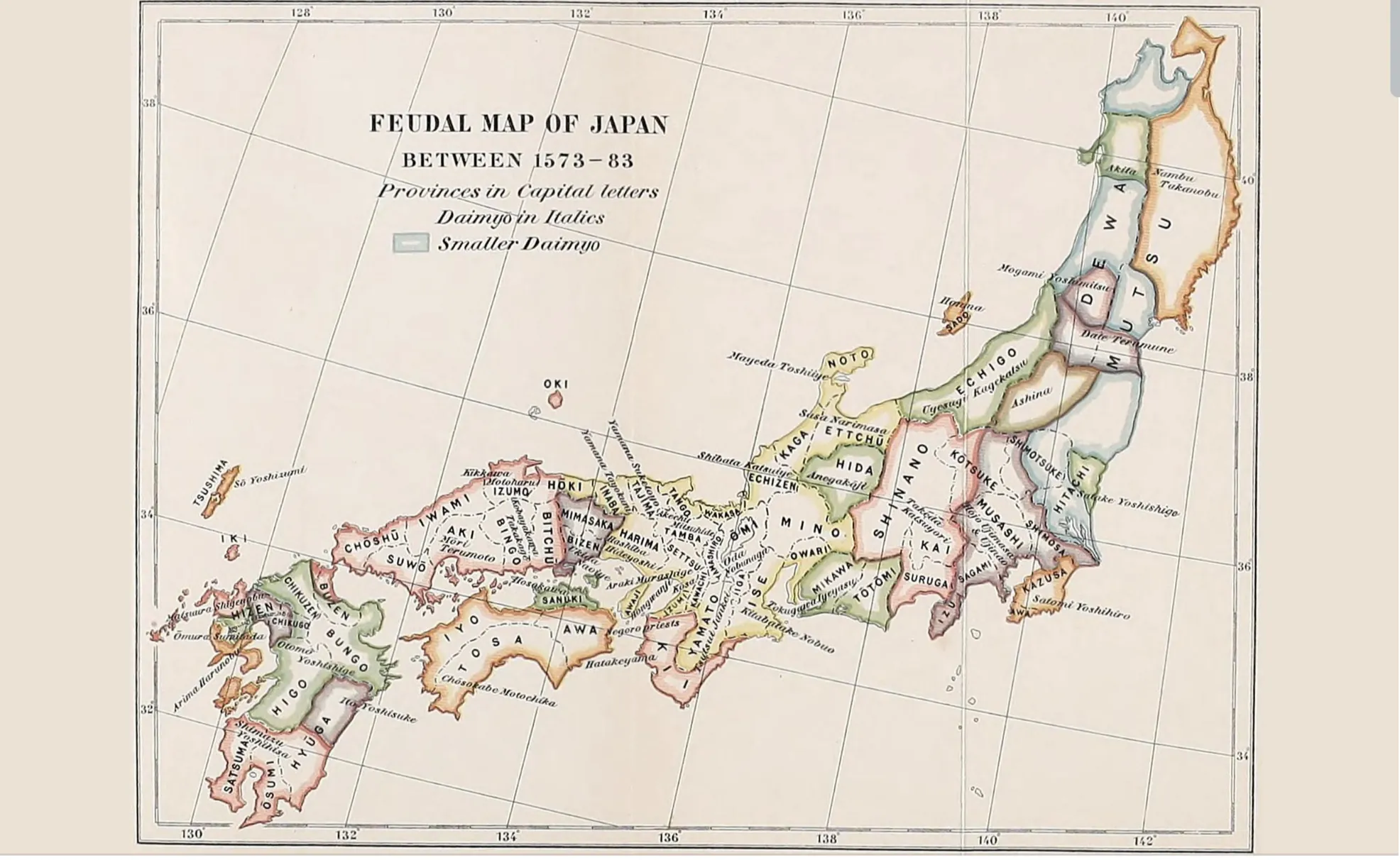
Feudal Map of Warring States Japan
1576

The Battle of Tennoji

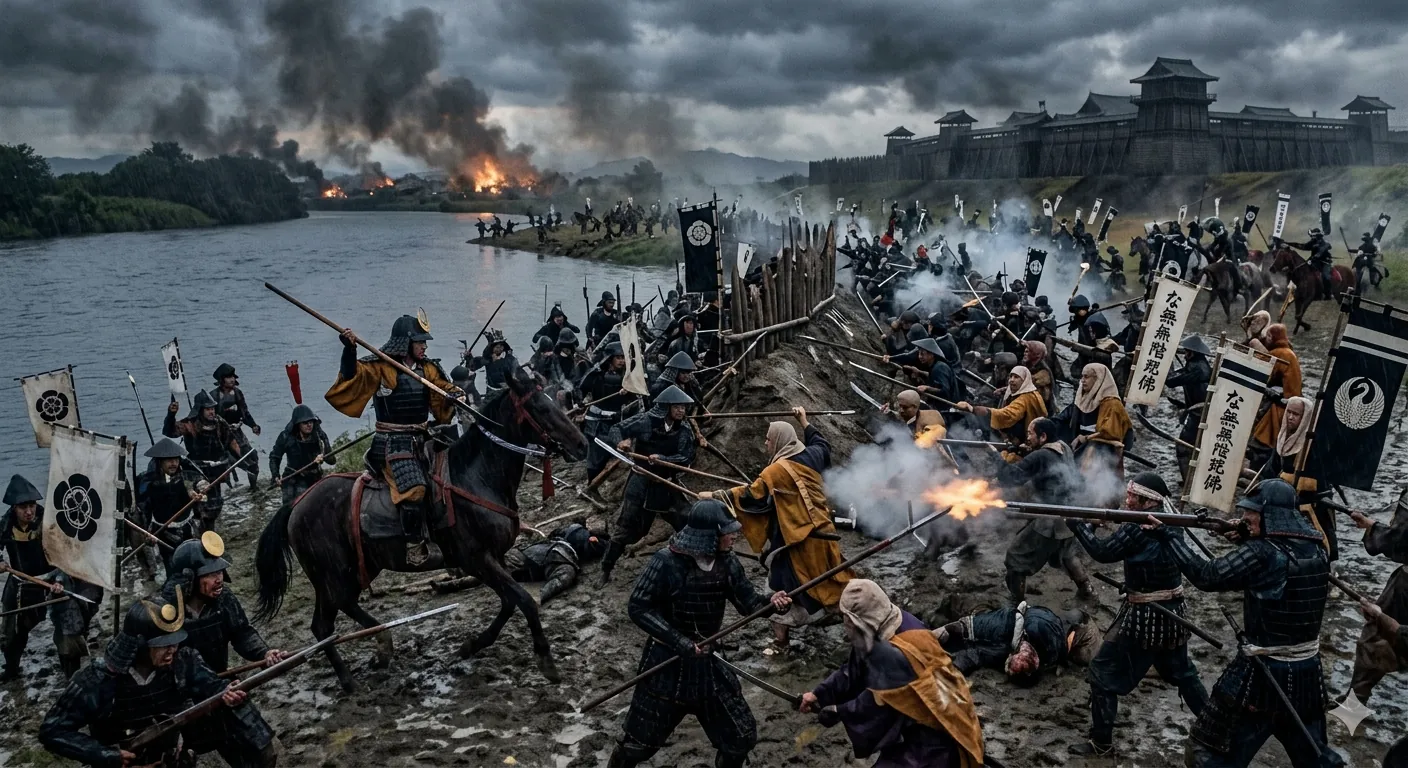
Realizing how costly a direct assault would be, Nobunaga’s forces constructed a ring of ten strategic forts—including Tennoji and Mitsumatsu—to choke off the land routes to the Ishiyama Honganji. Faced with a slow death by starvation, the Ikko-ikki launched a massive breakout attempt to shatter this encirclement.

The conflict began when 15,000 defenders surged out of the fortress to assault the Oda siege lines. They successfully pinned down the Oda vanguard under Akechi Mitsuhide and Araki Murashige, threatening to collapse the entire blockade.

Nobunaga reinforced from Kyoto with only 3,000 men. Despite being outnumbered, he ignored the caution of his generals and personally led a charge to relieve his besieged forts.

The ferocity of the Oda counter-attack pushed the warrior-monks back to their gates, but the victory came at a high cost. Nobunaga was wounded by an arquebus shot to the leg, a rare moment of physical vulnerability.

Despite the land success, the strategic victory was snatched away by the sea. The Mori clan’s fleet arrived, smashing through the Oda blockade at the mouth of the Kizugawa River.

This naval breakthrough resupplied the fortress with food and ammunition, effectively nullifying Nobunaga's land gains and forcing an Oda withdrawal. It was a rare, humbling setback that ensured the Honganji would endure for years to come.
1576–1578

The Naval War and the Iron Ships

The Ishiyama Honganji was a nearly invulnerable fortress; as long as the Mori navy could ferry supplies through the Inland Sea, the monks could hold out indefinitely. Nobunaga realized that to win the war, he had to win the water.

In the first battle of Kizugawaguchi (1576), the Mori navy’s superior numbers and traditional tactics overwhelmed the Oda fleet, keeping the Honganji's lifeline open.

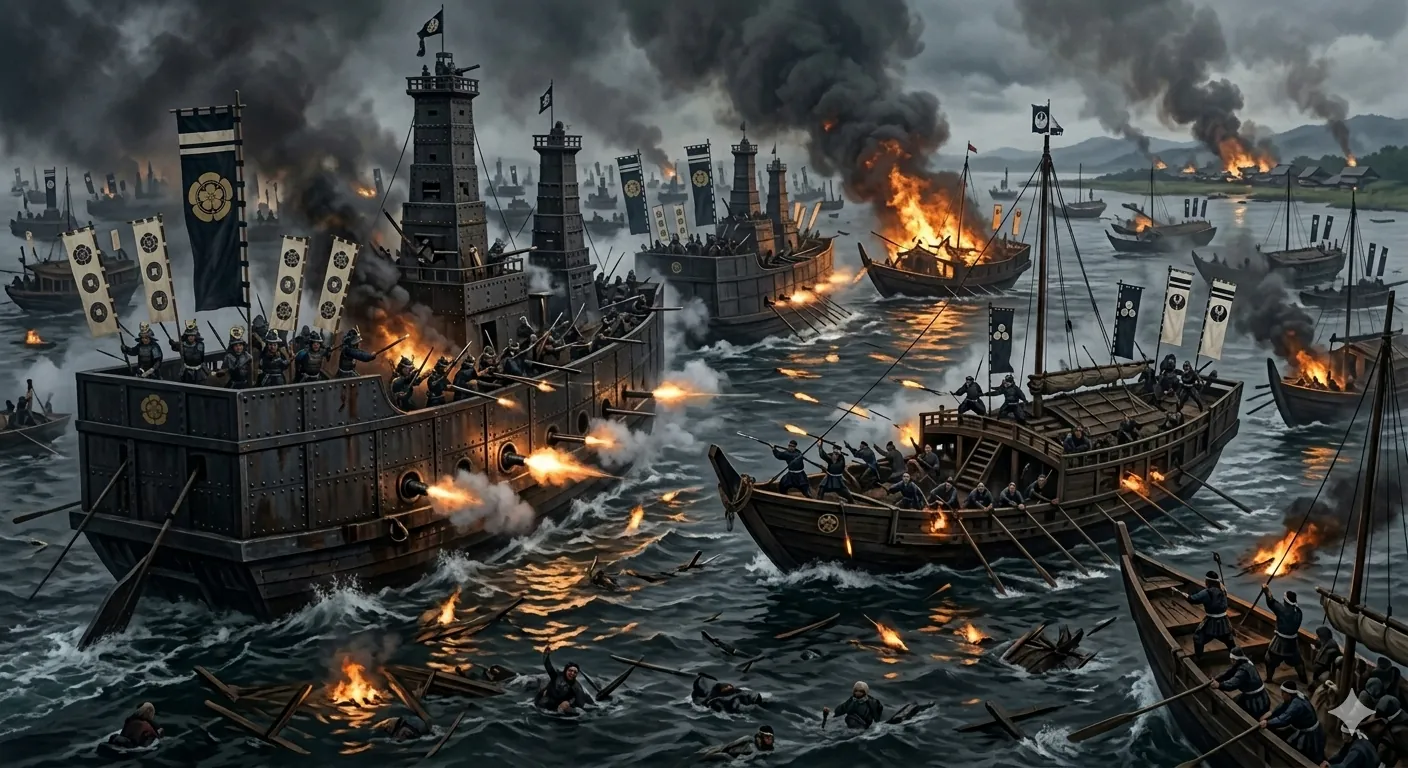
In response, Nobunaga commissioned the shipwright Kuki Yoshitaka to build six massive iron-armored atakebune. These were essentially the world's first "ironclads"—gigantic wooden warships reinforced with iron plates to deflect fire arrows and incendiary weapons.

Nobunaga's return match in 1578 was a massacre. The iron-plated vessels proved impervious to the Mori fleet's incendiary tactics. The Oda ships systematically crushed the opposition, permanently severing the sea routes to the Honganji.

Without their naval lifeline, the fortress was finally isolated, beginning the slow countdown to its eventual surrender.

Iron-armored Atakebune warships
1578–1580

The Final Phase

With the sea route closed, the Ikki begin to starve.

Shimozuma Nakayuki leads repeated sallies from the fortress, but ammunition and food run out.

By April 1580, the defenders are exhausted and isolated — yet the fortress still has not fallen by force.

1580

The Surrender and Scorched Earth

Nobunaga negotiates the surrender of Ishiyama Honganji through the Imperial Court, giving Kennyo Kosa an honorable exit.

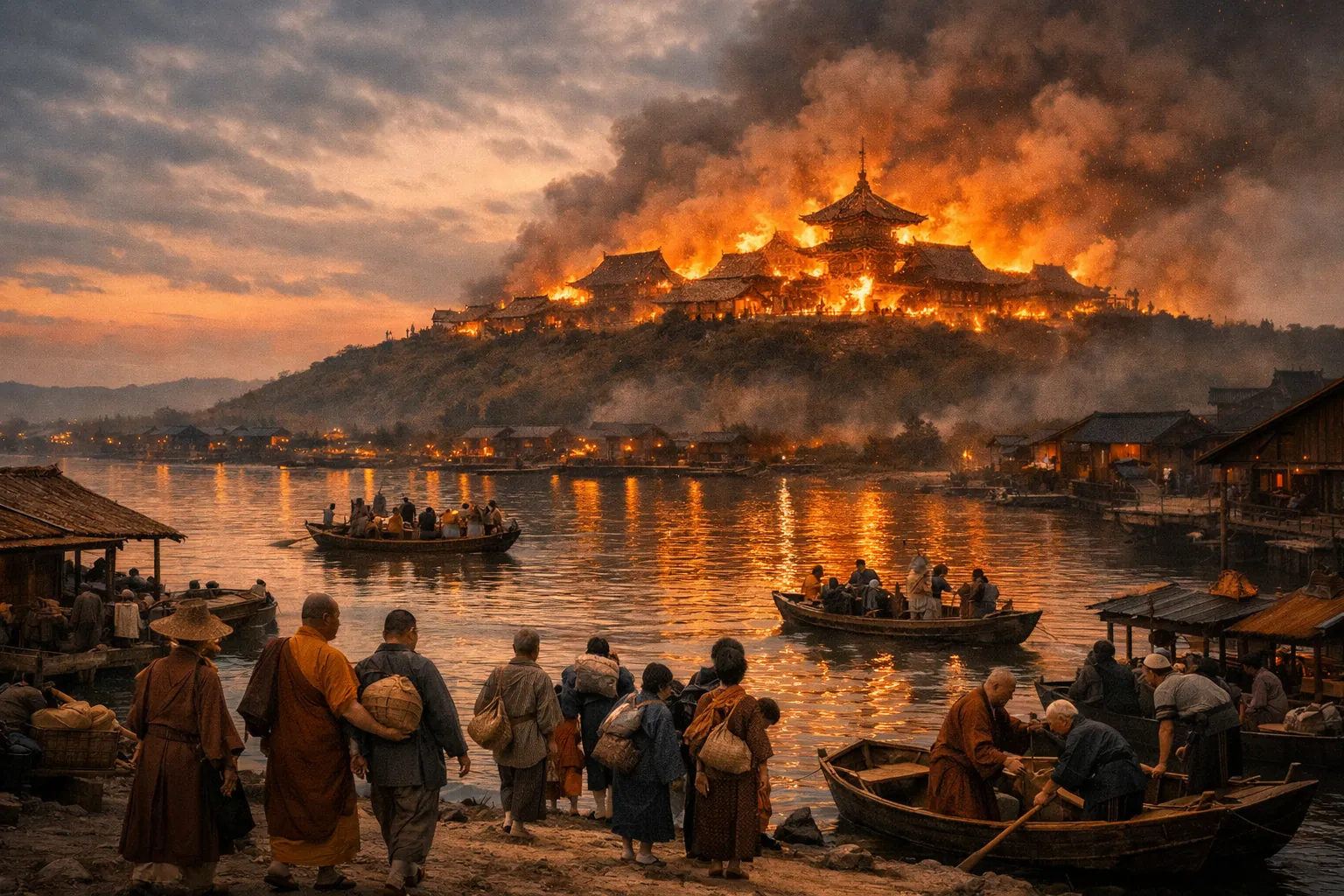
Once evacuated, the entire Ishiyama Honganji complex burns to the ground.

The fortress is never conquered — it is abandoned, then destroyed.

The burning of Ishiyama Honganji

Continue the Story at Osaka Castle

The fortress that burned in 1580 didn't disappear from the story — its ashes became the foundation. Hideyoshi built Osaka Castle directly on the ruins of the Ishiyama Hongan-ji, inheriting the same commanding site the warrior-monks had defended for a decade, and with it, the same target on its back.

If you'd like to understand the evolution of the three fortresses and why this site was chosen for all three, Warrior Monks, a Peasant, and a Shogun traces that story across the same ground, fortress by fortress.

Continue Exploring

The fortress that burned in 1580 didn't disappear from the story. Its ashes became the foundation of Osaka Castle, and the same ground holds the betrayals and battles that frame the siege.

Explore All 19 Stories of Osaka's History →

Stand on the buried fortress Nobunaga spent a decade failing to break.

Walk with a historian who lives beside it. Small groups. Osaka Castle every day • English • Max 6 guests

Book Warrior Monks, a Peasant, and a Shogun Call / Text Edward WhatsApp Edward

Edward Iftody — Osaka Castle’s Resident Historian